Low-Noise Measurement Microphones: How to Accurately Measure Quiet Sound Sources Below 20 dB(A)
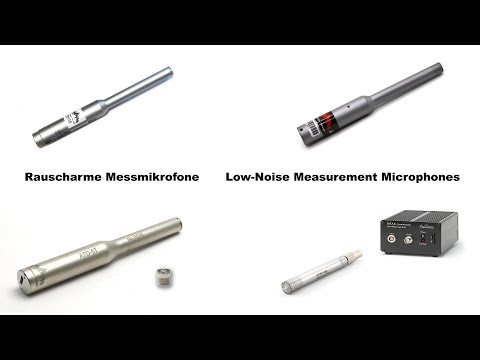
Whether ultra-quiet heat pumps, home cinema projectors, PC cooling fans, hard drives, or medical ventilation: standard sound level meters and 1/4" microphones hit a brick wall below 20 dB(A). Discover why capsule physics dictates the noise floor, how our 6 dB SNR rule prevents severe errors, and how 5.5 dB(A) sounds in our real audio shootout.
6 dB SNR & Clock Audio Test
4 original audio tracks (ECM8000 vs. UMIK-1 vs. ATD5-T vs. G.R.A.S. 40HL) plus interactive SNR validator.
The 5.5 dB(A) Capsule Magic
Why 1/4" hisses, 1" suffers high-frequency resonances, and how relaxed 1/2" capsules with preamp EQ work.
1 kHz USB Chirping Exposed
1 kHz packet modulation in cheap single-chip USB mics revealed via FFT, and our shielded ATD5-T/MV240 architecture.
Interactive Noise Floor Validator & the Benchmark Clock Listening Test
Verify with strict physics which microphone fits your target sound level. Listen to level-matched recordings of a mechanical clock at 50 cm – captured across four real systems ranging from 50 € to 6,000 €.
⚠️ Critical Warning: 1/4" Measurement Microphones (ECM8000, UMIK-1, MM1)
Compact 1/4" electret capsules exhibit a physical self-noise of 30 to 34 dB(A). They are excellent for loudspeaker testing or reverberation in loud rooms, but completely useless for quiet fans, nocturnal noise, or heat pumps below 30 dB(A). You will measure pure microphone self-noise!
If the acoustic signal is less than 6 dB above the microphone self-noise, sound energy adds up logarithmically. A 20 dB(A) fan on a 15 dB(A) mic yields 21.2 dB(A) (+1.2 dB error). On a 30 dB(A) mic it reads 30.4 dB(A) – an intolerable measurement error exceeding 10 dB!
Listening Test: Mechanical Clock at 50 cm (Strictly Level-Matched)
All 4 audio files were captured under identical laboratory conditions with a mechanical clock and rigorously normalized. Listen to where the signal disappears into the noise floor:
Dead quiet background. The clock ticks crystal clear; the finest escapement wheel harmonics are discernible with zero audible hiss.
Thermal noise of the 1/2" diaphragm. Clock is clearly audible with very mild broadband hiss and zero discrete USB chirping.
Heavy background hiss. Clock is audible but struggles against the dense noise floor of the 1/4" electret capsule.
Overwhelming noise wall. The ticking clock is practically masked by the aggressive capsule and preamp self-noise.
Low-Noise Microphones Lab Benchmark Shootout
Hands-on comparison of various capsules and preamplifiers in Dr. Jordan Design's anechoic chamber.
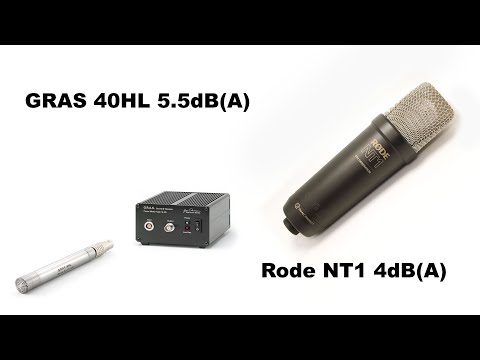
Large-Diaphragm Studio Mic (Rode NT1) for Measurements?
Why 1" studio capsules are low noise (4.5 dB(A)) but fail as measurement mics due to polar directivity and HF resonances.
The Physics Behind 5.5 dB(A): Why Capsule Size and Diaphragm Damping Rule
How is it physically possible for a 1/2" special microphone to be 10 dB quieter than standard 1/2" Class 1 capsules? The delicate balance between sensitivity, resonance, and active preamp compensation.
| Kapsel-Kategorie | Eigenrauschen | Grenzschalldruck | Vorteile | Physikalische Nachteile | Mess-Tauglichkeit |
|---|---|---|---|---|---|
| 1/4 Zoll (~6 mm) | 30 – 34 dB(A) | > 140 dB SPL | Superb omnidirectional response up to 40 kHz, minimal soundfield distortion. | Tiny diaphragm collects minute acoustic energy; high thermal resistance noise. | Unusable for low noise (< 35 dB(A)). Ideal for speaker design and high SPL. |
| 1/2 Zoll Standard (~12,7 mm) | 15 – 18 dB(A) | 135 – 146 dB SPL | The universal acoustic workhorse per IEC 61672 Class 1. Sensitivity 50 mV/Pa. | Thermal noise floor around 15 dB(A). Sound sources below 21 dB(A) violate 6 dB SNR. | The industry benchmark for 95% of industrial, building, and environmental tasks. |
| 1/2 Zoll Low-Noise Spezial (G.R.A.S. 40HL / MTG MMS214) HIGH-END | 5,5 – 6,5 dB(A) | 100 – 110 dB SPL | Extremely high sensitivity (> 300 mV/Pa). SNR comparable to large diaphragms in a 1/2" form factor. | Lower maximum SPL (100 dB SPL). Capsule and preamplifier are an inseparable matched pair. | The sole viable solution for quiet heat pumps, medical gear, disk drives, and high-transmission loss. |
| 1 Zoll & Großmembran (> 25 mm) | 4 – 10 dB(A) | 130 – 140 dB SPL | Very low self-noise due to enormous diaphragm surface area. | Pronounced directivity above 3 kHz, severe resonances, and sound field obstruction. | Superb for music recording, fundamentally unsuited for standard free-field metrology. |
⚡ The Engineering Secret of 5.5 dB(A): Compliant Diaphragm Tuning & Active Preamp EQ
To drastically suppress thermal diaphragm noise, the membrane is suspended with higher acoustic compliance. Sensitivity jumps from standard 50 mV/Pa to over 300 mV/Pa. A higher voltage directly at the diaphragm means downstream preamplifier noise becomes negligible.
The physical penalty of compliant suspension is a pronounced mechanical resonance between 8 and 10 kHz. This raw signal would fail IEC Class 1. The solution developed by leading labs (G.R.A.S., Microtech Gefell): the matched preamplifier contains an analog compensation filter mirroring the resonance.
For this reason, capsule and preamplifier in ultra-low-noise systems constitute an inseparable, factory-calibrated unit. They must never be split or operated with third-party preamps.
No Rental for 5.5 dB(A) Systems – Book Our Dresden Lab or On-Site Measurement Service!
Due to the extreme mechanical delicacy of ultra-thin membranes and five-figure calibration assets, systems such as G.R.A.S. 40HL or MTG MMS214 are never shipped via parcel rental. Instead, Dr.-Ing. Frank Jordan conducts precision testing of ultra-quiet devices (< 18 dB(A)) directly in our Dresden anechoic lab or on-site at your facility.
The 1 kHz USB Chirping: Why Cheap USB Microphones Whistle in the Metrology Lab
Every acoustician has encountered annoying high-pitched chirping on cheap USB microphones during quiet runs. The root cause is not acoustic, but the 1 ms packet modulation of the USB host controller. How to expose bus interference via FFT.
USB Full Speed and High Speed specifications transfer audio packets in frames at a 1/1000 s rate – exactly every 1.0 millisecond. Every data burst emits an electromagnetic transient across the 5V power and data lines.
Cheap USB mics rely on single-chip solutions (USB transceiver and ADC on the same die). 1 kHz bursts cross-talk into the high-impedance analog frontend. The result: sharp spectral spikes at exactly 1,000 Hz and harmonics at 2 kHz, 3 kHz, and 4 kHz.
Because human hearing exhibits peak sensitivity between 1 and 3 kHz, USB chirping sounds piercingly loud. In broad sound level readings its energy may be small, but it corrupts narrow-band FFT acoustic analyses.
Original recording of USB interference: clearly audible 1 kHz whistling and bus packet jitter.
📊 The Forensic FFT Proof
In a high-resolution Akulap FFT (10 s average in silence), the flaw is obvious: a well-shielded system displays a flat thermal noise floor. A poorly designed USB mic displays discrete Dirac spikes at 1,000 Hz, 2,000 Hz, and 3,000 Hz.
Dr. Jordan Design Shielded Architecture
In the ATD5-T and MV240, multi-stage LC filters and isolated ground planes eliminate 5V USB bus modulation.
Rugged, 360-degree shielded metallic LEMO connectors prevent ground loops and RF ingress from cell phones.
Standard 1/2" capsules (IEC 61094-4) from leading manufacturers (MTG, B&K, G.R.A.S.) with genuine 50 mV/Pa sensitivity.
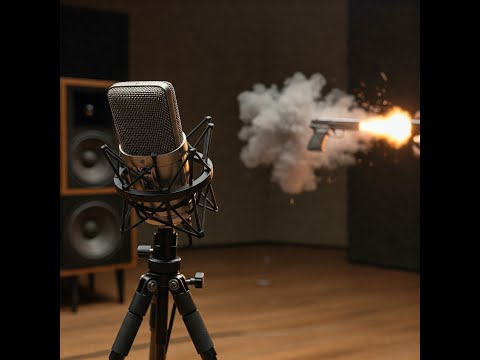
The Flip Side of Low-Noise: 130 to 170 dB Without Capsule Destruction
Measuring quiet signals requires ultra-compliant diaphragms. But what happens at the opposite extreme at 170 dB? Video guide to extreme acoustic pressures.
3-Way Configurator: From Calibrator to Ultra-Low-Noise Metrology Chain
Select the ideal tier for your metrology task. All prices loaded dynamically at build time with 100% PAngV compliance.
Sound Level Calibrators (Class 1 & 2)
Every valid measurement below 20 dB(A) requires on-site verification of the measurement chain at 94 or 114 dB.
Professional USB Measurement Chains (15–130 dB)
Shielded USB chains immune to 1 kHz chirping. Ideal for Akulap, FFT analysis, and workplace noise.
Ultra-Low-Noise Hardware & Lab Testing
Reference hardware down to 6.5 dB(A) and our Dresden laboratory measurement service for quiet devices.
Measurement of your device with G.R.A.S. 40HL (5.5 dB(A)) & APx555 reference chain.
✉️ Inquire Service