Is Infrasound Dangerous? What Physics and High-Precision Metrology Actually Show
Between alarming headlines about wind turbines and surprising everyday phenomena: As an acoustic metrology engineering firm, we focus strictly on measurable physical quantities—from human perception thresholds to the barometric squat experiment.
Moving Air Below 20 Cycles per Second: Inaudible, Yet Perceptible?
From a physical standpoint, the definition of infrasound is completely unspectacular: air pressure fluctuations at a frequency below 20 Hertz (Hz). While our hearing is extremely sensitive between 1,000 Hz and 6,000 Hz, sensitivity drops drastically toward low frequencies. Even a 50 Hz tone must be around 40 dB louder than a 1,000 Hz tone (a factor of 100 in sound pressure) just to be heard.
According to classical teaching, infrasound below 20 Hz was considered inaudible. Extensive studies by the Physikalisch-Technische Bundesanstalt (PTB) in Braunschweig—including fMRI brain imaging down to 8 Hz—have refined this view: infrasound is perceptible in principle, but requires extremely high sound pressure levels.
At extreme levels (such as an explosion or specialized acoustic weapons), infrasound is undoubtedly dangerous. At the very low levels produced by wind turbines, science can currently neither prove beyond doubt that they are completely harmless nor prove the opposite. Where belief begins, we provide strictly measurable facts.
Why a Simple Squat or Opening a Fridge Door Exceeds a Wind Turbine by Orders of Magnitude
A common logical fallacy goes: 'Infrasound causes dizziness. Wind turbines generate infrasound (0.5 to 20 Hz). Therefore, wind turbines cause dizziness.' This ignores a basic rule of physics: the dose (level) makes the poison. Infrasound is not a synthetic modern phenomenon; it is constantly generated by wind turbulence, ocean surf, and our own movements.
The most striking proof can be demonstrated live in our lab: atmospheric air pressure decreases with altitude. If you move your head up and down by just one meter once per second during a squat or on a garden swing, your eardrum experiences a periodic pressure fluctuation of roughly 12 Pascals—equivalent to an infrasound level exceeding 110 dB at 1 Hz!
Orders of Magnitude in Direct Comparison
Want 100% Protection from Infrasound? NEVER Do These 4 Things!
If minimal infrasound levels below the perception threshold caused illness merely by their physical existence, you would have to strictly obey the following rules in everyday life:
Never Drive a Car or Ride a Train!
Even a short trip exposes you to many times the infrasound level of a wind farm.
Never Open Doors or Your Refrigerator!
Every door opening generates a massive infrasound pulse in the room far exceeding any wind turbine.
No Squats, No Swinging, Do Not Stand Up!
Every 1-meter vertical head movement dramatically alters the barometric pressure at your ear.
Never Visit the Ocean or Step into the Wind!
Ocean surf and wind gusts hitting trees are the strongest continuous infrasound sources of all.
Our thought experiment illustrates physical context: anyone afraid of the pure infrasound from a distant wind turbine would have to sit completely motionless in everyday life and never open a window again. Why does a wind turbine still feel threatening? Because our brain subconsciously links the imposing visual presence and the audible periodic swish of the blades together.
Our comparison is by no means intended to trivialize your suffering, but to demonstrate that the true trigger almost always lies in the audible low-frequency range (30–100 Hz) — and not below 20 Hz. However, when someone is convinced that inaudible infrasound is harmful, persistent alarm states release stress hormones that cause genuine, distressing symptoms.
Indoor Hum: Is It a Heat Pump, 50 Hz Mains Hum, or Low-Frequency Tinnitus?
While true infrasound (< 20 Hz) is almost never the cause of indoor complaints, low-frequency noise between 30 Hz and 200 Hz (e.g., from heat pumps, CHP units, transformers, or room modes) regularly causes severe distress. With three simple steps, you can systematically narrow down the cause:
Why Humming Sounds Loudest in the Bedroom
Below 100 Hz, standard windows and light insulation materials are nearly transparent to sound, and the source cannot be localized. Because carpets, curtains, and mattresses in bedrooms absorb only high frequencies, the remaining low-frequency room resonance stands out starkly.
Low-Frequency Tinnitus vs. External Source
Tinnitus does not always manifest as a high-pitched ringing; it often sounds like a distant idling diesel truck. If even high-grade active noise-cancelling headphones (30–200 Hz) bring zero relief and our most sensitive instruments detect no signal, the auditory system is usually failing to filter out internal blood-flow vibrations.
No 'Neighbor Infrasound Weapons'
We do not process inquiries regarding alleged 'malicious neighbor infrasound generators' or vague 'radiation'. Due to the enormous wavelength, high infrasound levels can barely be generated even with refrigerator-sized subwoofers—and if such levels existed, the neighbor's own apartment would be uninhabitable.
We frequently receive inquiries from residents suffering from distressing sleep issues, ear pressure, or unexplained low-frequency vibrations in their homes. We take these complaints very seriously. That is precisely why we caution against premature judgment: dismissing suffering as merely psychosomatic helps no one, nor do alarmist myths. The only reliable path to clarity—for regulatory action or court proceedings—is rigorous, standardized measurement using precision-calibrated equipment. Our systems record sound pressure levels objectively, reproducibly, and with forensic validity per DIN 45680 and DIN/TS 45610.
🎧 Acoustic Physics Compared: Why ANC Headphones Tame Deep Hum While Earmuffs Fail—and Why ANC Stops Working for Infrasound ▼
1. Passive Hearing Protection (Classic Earmuffs): Passive earmuffs attenuate sound via mass-spring damping. At high frequencies (> 1,000 Hz, short wavelengths of a few centimeters), sound waves are absorbed effectively by the cup and foam liner (often 30 to 40 dB attenuation). At low frequencies (e.g. 50 Hz with a 6.8 m wavelength, or 20 Hz with a 17 m wavelength), the thin plastic shell is practically transparent to the wave. Passive noise reduction collapses to an underwhelming 0 to 5 dB! Furthermore, high-level low-frequency acoustic energy bypasses the ear canal entirely via skull bone conduction directly into the cochlea.
2. ANC Headphones (Active Noise Cancelling / Antiphase Sound): ANC exploits destructive interference. Microphones on the earcups detect ambient noise, an ultra-fast digital signal processor (DSP) generates a 180° phase-inverted cancellation wave within microseconds, and the transducer radiates this antinoise directly into the small, sealed ear volume. Between 40 Hz and 500 Hz (typical of transformer hum, heat pumps, compressors, and fans), wavelengths inside the ear canal are ideal for closed-loop control and DSP latency is negligible. ANC achieves a remarkable 20 to 30 dB of real attenuation—eliminating low-frequency hum where passive muffs fail completely!
3. Why ANC Systems Cease to Work for True Infrasound (< 20 Hz): Below 15 to 20 Hz, active headphones encounter fundamental physical barriers: First, miniature headphone drivers cannot generate the enormous diaphragm excursion volume required to produce canceling sound pressure at infrasonic wavelengths. Second, manufacturers intentionally implement steep high-pass filters below 15–20 Hz to prevent low-frequency pressure pulses (footsteps, head motion, or wind buffeting against ear cushions) from clipping the amplifier or damaging the driver. Third, high-level infrasound is perceived bodily through the thorax, abdomen, and skull, against which an in-ear or over-ear device provides zero protection.
How Infrasound and Low-Frequency Immissions Are Reliably Measured
Basic handheld sound level meters (with 1/4-inch capsules, 30 Hz lower cutoff, and 30 dB(A) self-noise) or uncalibrated smartphone apps are useless for low-frequency analysis. A qualified expert uses low-noise 1/2-inch capsules (< 20 dB(A), down to 6 dB(A) in our lab), calibrated signal paths, and standardized spectral analysis.
🔬 Hardware Category A: Extreme Infrasound from 0.5 Hz (Lab & Reference)
Specialized laboratory measurement chain for the lowest frequencies down to 0.5 Hz (2-second oscillation periods) with minimal internal self-noise.
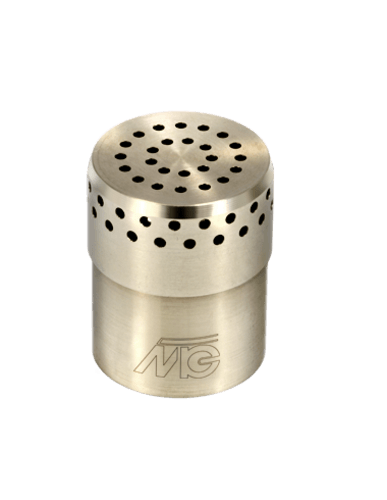
Microtech Gefell MK 222 (1/2 Inch WS2F)
Specialized measurement microphone capsule per IEC 61094-4 with extended low-frequency response down to 0.5 Hz, 15 dB(A) self-noise, and 50 mV/Pa sensitivity (fits MV240).

Microtech Gefell MV240 USB Measurement Preamp
High-precision digital 1/2-inch USB measurement microphone system (ships without capsule—combine with the MK 222 infrasound capsule or MK 250 Class 1 capsule).
📱 Hardware Category B: Low-Frequency Sound & Infrasound from 5 Hz (Field & On-Site Measurement)
Rugged, field-proven measurement instruments for on-site assessment of hum, heat pumps, industrial machinery, and infrasound from 5 Hz.

Akulap USB Measurement Microphone (1/2 Inch, Class 2)
Our proven workhorse measurement microphone for Akulap: selected 1/2-inch capsule with standard 60UNS thread (calibrator compatible), frequency response from 5 Hz, and 19 dB(A) self-noise. Major benefit: the Akulap license dongle is integrated directly inside the mic body (Plug & Play, no separate USB dongle needed).

Bedrock SM50 Class 2 Analyzer
Portable Class 2 precision handheld analyzer featuring integrated real-time 1/3-octave analysis (down to 8 Hz), FFT, C/A/Z frequency weighting, and WAV logging. Important: For Class 1 certification and lower self-noise, the upgrade model Bedrock SM90 (Art. #345677) is available.
🎯 Acoustic Calibration for All Hardware Systems (Mandatory Before Every Test Run)
Court-admissible and standard-compliant measurements strictly require acoustic calibration before and after every measurement series.

Sound Level Calibrator Center 326 (1 kHz, Class 2)
Precision acoustic calibrator for 1/2-inch and 1/4-inch microphones per IEC 60942 Class 2. Generates exactly 94.0 dB and 114.0 dB at 1,000 Hz. Indispensable before and after every field measurement for validated absolute sound pressure level documentation.
💨 Essential Field Requirement: Primary & Secondary Wind Protection for Outdoor Measurements ▼
💻 Software Analysis per DIN 45680 & DIN/TS 45610:2026
Certified PC software for sound level measurement, narrowband FFT, real-time 1/3-octave analysis, and automated hearing threshold comparison.

Akulap Base Measurement System (SPL & FFT)
The core measurement and analysis software for PC and laptop: high-precision sound level measurement (LAF, LAS, LCpeak, LZeq), high-resolution narrowband FFT, real-time 1/3-octave spectra, direct WAV logging, and automated PDF reporting.

Akulap Module DIN 45680 & DIN/TS 45610:2026
Specialized module for standard-compliant measurement and assessment of low-frequency noise immissions in residential buildings per DIN 45680:1997 and the new VDI / DIN/TS 45610:2026. Features 1/3-octave analysis from 8 Hz to 100 Hz, automated comparison against human hearing thresholds, and tonal prominence tests.
Rent Infrasound & Low-Frequency Metrology Instead of Buying
Need precision instrumentation for a temporary survey, compliance measurement, or noise immission assessment? Through our rental portal, we provide pre-calibrated Class 1 and Class 2 systems (Bedrock, Gefell, NTi, Svantek) on a flexible weekly basis. Dedicated acoustic engineering consulting and data analysis can be booked alongside as needed.
Frequently Asked Questions on Infrasound & Low-Frequency Hum
How can I tell with a basic meter whether low-frequency sound is present? ▼
Measure the sound pressure level in 'Slow' mode once with A-weighting and once with C-weighting. Because the A-curve heavily attenuates low frequencies, a difference exceeding 10 to 20 dB (C-value significantly higher than A-value) is a strong indicator of low-frequency energy between 30 and 100 Hz.
Why requires wind special attention during infrasound measurements near wind turbines? ▼
Wind not only changes the turbine's rotor speed, it also creates strong air vortices (flow turbulence) directly at the microphone diaphragm. Without specialized secondary windscreens, these pseudo-acoustic wind pressures massively distort measurements below 20 Hz.
What does an interference frequency of exactly 50 Hz or 100 Hz indicate? ▼
If the disturbing tone sits at exactly 50 Hz or integer multiples (100 Hz, 150 Hz, 200 Hz), it almost always originates from mains-synchronized electrical equipment (transformers, pumps, compressors). Great care must be taken during measurement to rule out electrical ground loops in the measurement chain.
Is a smartphone app or a WAV/MP3 audio recording sufficient as proof? ▼
Apps are at best useful for roughly identifying the frequency of a prominent hum above 30 Hz. Because smartphone microphones roll off sharply below 100 Hz and are uncalibrated, neither apps nor standard audio recordings provide a reliable decibel reference to the human hearing threshold.
Why can't I measure infrasound with a budget sound level meter costing €30 to €100? ▼
Budget sound level meters fail completely when measuring infrasound (< 20 Hz) and low-frequency hum due to four physical constraints: 1. Low-Frequency Cutoff: Inexpensive meters incorporate built-in analog high-pass filters that sharply roll off frequencies below 20 to 31.5 Hz (below 20 Hz they show zero or suffer massive errors). 2. High Capsule Self-Noise: Budget 1/4-inch capsules typically have 35–45 dB(A) noise floors, drowning out faint low-frequency signals. 3. Drastic Attenuation by the A-Weighting Curve: A €30 meter typically displays only a single sum in dB(A). Standard A-weighting radically suppresses low frequencies: at 80 Hz it attenuates by -22.5 dB, at 50 Hz by -30.2 dB, and at 31.5 Hz by nearly -40 dB (a factor of 100 in sound pressure)! A meter measuring only dB(A) is essentially deaf to low-frequency noise. At a minimum, C-weighting (dBC) must be used: if the C-level exceeds the A-level by 15 to 20 dB (LC − LA > 15–20 dB), this provides clear screening evidence of dominant low-frequency energy. 4. Lack of Spectral Analysis & Outdoor Wind Protection: Budget meters offer neither narrowband FFT nor standard 1/3-octave filters (IEC 61260) to identify the specific frequency, nor mounting fixtures for secondary windscreens in outdoor environments. For standard-compliant assessment per DIN 45680 / DIN/TS 45610, professional spectral instrumentation is essential.
Are there budget DIY alternatives? Can industrial pressure sensors measure infrasound? ▼
Yes, in do-it-yourself (DIY) and meteorological setups, sensitive industrial differential pressure sensors (microbarometers) can fundamentally be used to detect extreme infrasound. However, this approach entails major metrological strengths and limitations: • Advantage (Extreme Infrasound): Piezoresistive or capacitive pressure transmitters typically lack the sharp acoustic high-pass roll-off of audio microphones, capturing pressure pulses down to 0.1 Hz or even static atmospheric pressure shifts. • Low Sensitivity for Faint Immissions: Industrial transducers are typically designed for HVAC or filter monitoring (ranges often ±50 to ±500 Pa). Faint infrasound immissions in the millipascal range (mPa, below 50–60 dB SPL) completely drown in the transducer's internal noise floor and ADC quantization noise. • Upper Frequency Ceiling (Typically ~20 Hz): Mechanical damping, port geometry, and internal sampling rates restrict their bandwidth to a ceiling of approx. 15 to 20 Hz. Audible sound (such as a 50 Hz hum or 100 Hz transformer harmonics) cannot be captured simultaneously. Correlating inaudible infrasound with audible noise is impossible. • Severe Calibration Challenges: Industrial sensors do not fit standardized 1/2-inch acoustic calibrators (such as the Center 326 at 1 kHz). Reliable absolute calibration demands sealed low-frequency pressure chambers or specialized pistonphones operating at 2 to 10 Hz—making this route largely impractical for legally robust or certified reports.
Why do you recommend the Bedrock SM50 or comparable hand-held sound level meters for low-frequency measurements? ▼
The Bedrock SM50 is a fully standard-compliant sound level meter capable of measuring all relevant acoustic parameters strictly according to DIN EN 61672 (IEC 61672-1). For standard-compliant and legally robust assessment of low-frequency noise per DIN 45680:1997 and DIN/TS 45610:2026, spectral 1/3-octave band analysis starting at 8 Hz is mandatory. A single summary level (such as dB(A) or dB(C)) is completely insufficient because discrete narrowband tones or peaks must be identified and compared against the frequency-dependent perception threshold. This built-in 1/3-octave analysis according to IEC 61260 is reserved for professional instruments like the Bedrock SM50. Equally well suited for these demanding measurement tasks are professional hand-held analyzers from NTi Audio (XL2 or XL3) and precision sound level meters from the Svantek series (e.g. SV 971A or SV 977D). Rental & Consulting Option: For temporary measurement surveys or acoustic assessments, purchasing expensive instrumentation is not required. Through our rental service (/vermietung/), you can rent pre-calibrated systems on a flexible weekly basis and book dedicated consulting and measurement data review by our acoustic engineers as needed.
Do I strictly need a Class 1 system for infrasound and low-frequency measurements, or is Class 2 sufficient? ▼
Condenser microphones are physically exceptional transducers for low and ultra-low frequencies: at low frequencies, diaphragm displacement is directly proportional to sound pressure. In theory, a hermetically sealed condenser microphone could measure down to 0 Hz (static atmospheric DC pressure) — which would effectively make it a barometer. In acoustic practice, this barometric effect is deliberately unwanted, as weather fluctuations or opening doors would constantly force the sensitive diaphragm against its backplate. Measurement capsules therefore feature precision static pressure equalization vents (capillaries) that act as an acoustic high-pass filter, setting a defined lower cutoff (e.g. 0.5 Hz for specialized infrasound capsules like the MK222, or typically 3.5 to 5 Hz for standard capsules). Key takeaway for class comparison: • In the low and infrasonic frequency range (up to approx. 1 kHz), Class 1 and Class 2 instruments per IEC 61672-1 exhibit virtually identical frequency responses and tolerances. • The primary tolerance divergence between Class 1 and Class 2 occurs at high frequencies around 8 kHz (where Class 2 permits wider deviations), as well as in stricter temperature and operating environment stability requirements for Class 1. Conclusion for equipment selection: For diagnostic screening, root-cause investigations, internal monitoring, or pre-compliance surveys at wind turbines and heat pumps, a Class 2 system (such as the Bedrock SM50 or our calibrated USB measurement microphone) is physically more than adequate. However, certain formal regulatory standards, official licensing procedures, and forensic court disputes (e.g. TA Lärm in Germany) legally mandate a certified Class 1 instrument — for which we recommend the Bedrock SM90, the Bedrock AM100, the NTi Audio XL3, precision sound level meters from the Svantek series (e.g. SV 971A or SV 977D), or the Gefell precision laboratory chain.
How do I identify reputable service providers for infrasound and hum measurements (and avoid pseudoscience)? ▼
In the field of infrasound and low-frequency hum investigations, numerous providers operate with vastly different and sometimes questionable qualifications. Because affected individuals often suffer from persistent sleep deprivation and distress, this anxiety is unfortunately sometimes actively exploited: 1. Deliberate Deception vs. Pseudoscience: A small fraction of providers act outright fraudulently — fully aware that their equipment cannot produce physically valid measurements, yet selling costly 'reports' or ineffective 'neutralization gadgets'. A much larger group operates on dangerous half-knowledge acquired from internet forums without any rigorous training in acoustics, physics, or metrology. Common red flags include using uncalibrated smartphone apps or consumer audio microphones, which interpret internal instrument noise floors as alleged 'signals'. 2. Verify Equipment Suitability: Ask the service provider specifically about their instrumentation: • Frequency Range: Is the entire measurement chain (capsule, preamplifier, data acquisition) certified and specified down to 0.5 Hz or 8 Hz? • Acoustic Calibration: Are microphones field-calibrated immediately before and after the survey using a compliant acoustic calibrator (IEC 60942 Class 1 or 2)? • Spectral Resolution: Does the system record true narrowband FFT and 1/3-octave spectra compliant with IEC 61260, or merely arbitrary single-number decibels? 3. Demand Verifiable Acoustic Expertise: A reputable consultant (e.g. graduate engineer in acoustics, building physics, or physical metrology) demonstrates a thorough understanding of physical wave propagation (standing waves, room modes, structural vibration and flanking transmission) and strict adherence to standardized measurement codes (DIN 45680:1997, DIN/TS 45610:2026, TA Lärm). Legitimate acoustic experts provide objective, transparently documented measurement protocols compared against standardized perception thresholds — rather than selling esoteric shielding or stoking unfounded fears.
I want to offer measurement services in this field myself — how can I demonstrate to anxious clients that I work with rigorous integrity? ▼
Because the market for infrasound and hum investigations is heavily contaminated by uncalibrated smartphone apps and dubious 'neutralization/shielding' sellers, clients frequently view new service providers with deep skepticism. At the same time, no official state accreditation or government stamp exists specifically for this practical niche (systematic on-site root-cause analysis of hums and infrasound in residential and commercial buildings). To provide reputable engineering consultancies, building experts, HVAC engineers, and building biologists with an unmistakable mark of trust, we issue our own Dr. Jordan Design Quality Seal (Certificate of Technical Expertise & Measurement Chain Audit): • 1. Acoustic Expertise Review: In a dedicated technical interview, Dr.-Ing. Frank Jordan evaluates your acoustic knowledge (physical wave fundamentals, mandatory calibration procedures, correct application of DIN 45680 / DIN/TS 45610, and avoidance of typical measurement pitfalls). • 2. Transparent Equipment Documentation (Capabilities & Limits): We record your exact hardware and software setup. Your certificate documents in detail which frequency ranges and tasks you can measure with physical validity (e.g. low-frequency noise starting at 5 Hz or 8 Hz) — and where technical limitations lie (e.g. no extreme infrasound from 0.5 Hz or no official Class 1 compliance if a Class 2 sound level meter is used). • 3. Public Verification on Our Website: You receive an official certificate, which we also host as a verifiable reference on our website. Your clients can verify online at any time that your instrumentation and technical expertise have been successfully audited. • 4. Direct Benefit from Our Premier Search Rankings (Google & AI Visibility): For years, our technical portal has achieved top search engine rankings for queries surrounding infrasound, low-frequency hums, DIN 45680, and acoustic metrology, serving as a primary technical reference for modern AI systems. Because we receive daily inquiries from across the German-speaking region that we cannot all handle locally from our headquarters in Dresden, we refer clients directly to our public registry of certified partners. Through your listing, you benefit immediately from our organic reach and acquire qualified new clients in your region — without needing your own advertising budget. Important Transparency Note: This certificate is deliberately not a sovereign state license or DAkkS accreditation, as no such government credential exists for this specific practical field. It is our own independent engineering quality seal, backed personally by Dr.-Ing. Frank Jordan with over 25 years of metrological reputation — and granted solely when both the measurement chain and technical knowledge satisfy our rigorous physical standards.
Measure & Simulate Low-Frequency Noise Legally Compliant Online
Visit our specialized DIN 45680 expert portal: featuring an interactive WebAudio hearing threshold simulator, day/night threshold calculators, and Class 1 rental measurement kits for on-site assessment.